
Solar Roof Integration for Commercial Buildings in Boise, ID
Rooftop Solar Starts With the Roof Underneath It
A photovoltaic array is a 25-to-30-year asset bolted to whatever membrane happens to be there the day the panels go up. We see the consequences of skipping that math all over the Treasure Valley: a sound-looking flat roof with eight years left, an array installed on top of it, and then a forced de-rack three years early when the membrane finally gives out. On a 200-kilowatt system, pulling the array, storing it, reroofing, and reinstalling can add tens of thousands of dollars that nobody budgeted for. Our role at the front of a solar project in Boise is to tell you, honestly, whether the roof under your panels will outlive the financing on them.
Boise's commercial solar push is concentrated where the roofs are biggest and the daytime loads are highest. The distribution and light-industrial buildings off Gowen Road near the airport, the big-box and tilt-up inventory along the Franklin Road and Overland corridors, the warehouse stock in the Garden City industrial belt, and the employer campuses out toward Meridian all carry the wide, low-slope decks that ballasted PV likes. Idaho Power's net-metering structure and the long high-desert sun season make the generation case work here. None of that matters if the substrate underneath is wrong.
Membrane Compatibility and the Right Substrate
Not every roof we walk is a good solar candidate, and not every membrane behaves the same way under an array. White reflective single-ply gives us the best starting point: a 60-mil TPO or PVC system lowers the surface temperature beneath the modules, which keeps cell operating temperatures down and protects the panels' rated output through the summer. We also like that single-ply gives a clean, uniform plane for laying out racking rows and ballast trays.
EPDM and aged modified-bitumen assemblies are workable but need scrutiny. Dark EPDM runs hot under glass, and a roof already past its midlife should usually be recovered or replaced before it carries a 30-year array. Where we find sound membrane with real service life left, we map every existing patch, seam repair, and penetration so the solar layout routes around the weak spots rather than trapping them under panels we can never easily lift again.
- We confirm the membrane type, thickness, and manufacturer before any racking layout is approved.
- We document remaining service life in writing so your finance and facilities people can decide reroof-now versus solar-now with real numbers.
- We flag membranes that should not carry a long-life array at all, and say so before contracts are signed.
Racking, Penetrations, and Keeping the Membrane Watertight
Every connection between a solar array and a roof is either a penetration we have to flash or a ballast load the deck has to carry. Ballasted racking is the common answer on Boise's flat industrial roofs: weighted trays hold the array down without piercing the membrane, which keeps the waterproofing intact. The catch is weight. We pair the ballast plan against the building's structural capacity, because a lot of the older tilt-up and bar-joist stock around Franklin Road was designed to lighter snow-and-dead-load assumptions than a fully ballasted array imposes.
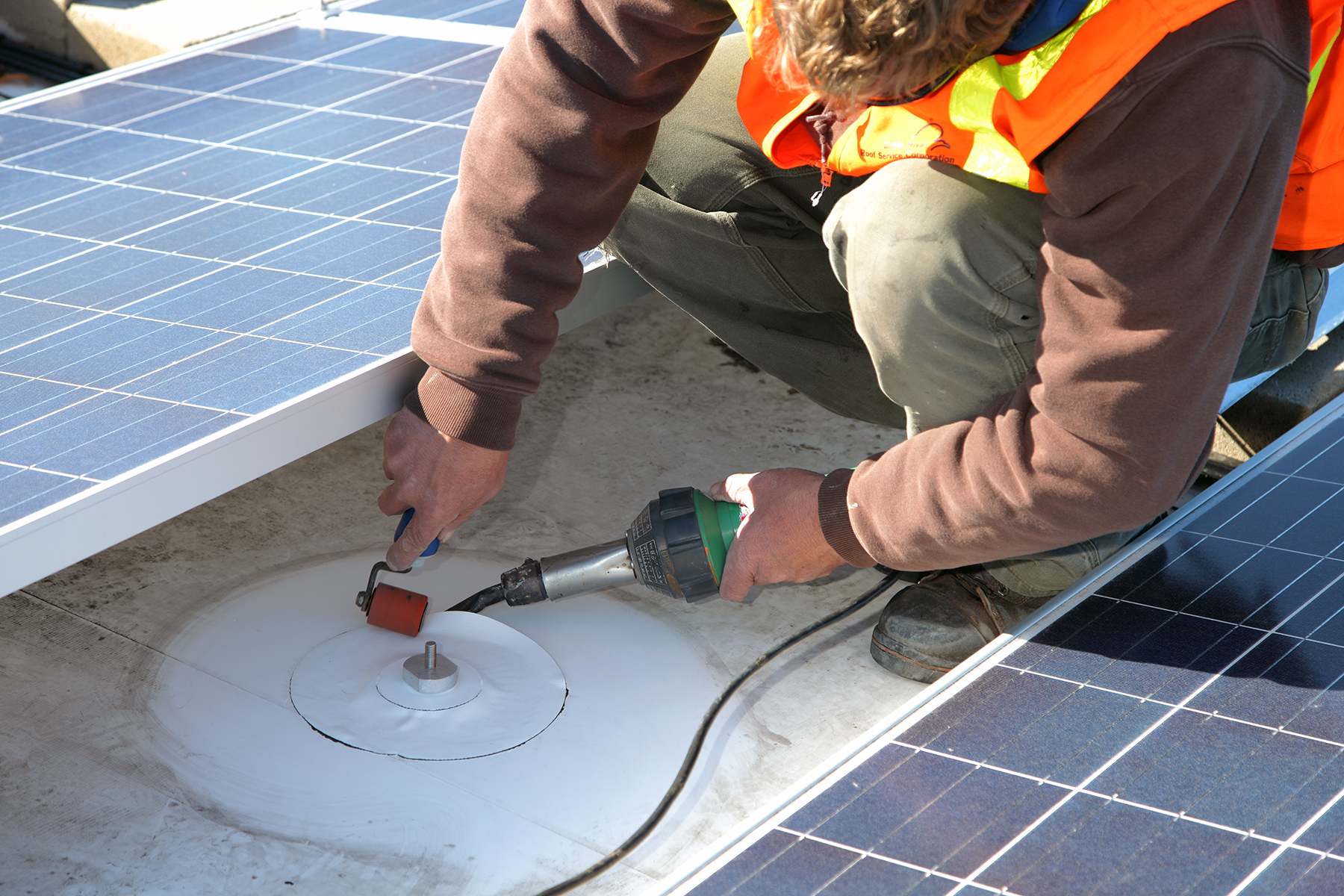
When a structural engineer or a high-uplift exposure forces mechanically attached racking, the math flips to penetrations. Each attachment foot becomes a hole through the membrane that has to be flashed to the manufacturer's detail, not boot-and-caulk improvisation. We install the flashings, we tie them into the field membrane, and we keep them inside the warranted assembly. The same goes for the conduit and combiner runs the solar electrician needs to drop into the building.
Wind Uplift and Edge Conditions
An array changes how wind loads the roof. Panels at the perimeter and corners see the highest uplift, and a ballast count that is fine in the field can be short at the edges where Boise's gusts and the occasional spring windstorm concentrate pressure. We make sure the racking design accounts for perimeter and corner zones, that edge metal and parapet conditions are sound before panels go up, and that the array layout respects the setbacks the membrane and code require around the roof edge.
Conduit and Penetration Coordination
The leaks we get called back to on solar roofs almost always trace to conduit. A run fastened flat to the membrane abrades it with every thermal cycle; a service penetration sealed with a generic pipe boot instead of a proper through-roof detail weeps within a season or two. We sit down with the solar EPC before the electrician shows up, agree on conduit routing and standoff heights, and reserve the membrane penetrations for ourselves so they are flashed once and flashed right.
Warranty Coordination Between Roofer and Solar Installer
The fastest way to void a perfectly good roofing warranty is to let a solar crew penetrate it without the membrane manufacturer's sign-off. Major single-ply manufacturers will keep a warranted system intact under solar, but only when the array uses approved ballast pads and walk pads, approved penetration details, and a pre-installation review by their technical rep. We run that review, we get the layout blessed, and we make sure the as-built array matches what the manufacturer approved.
That leaves two warranties that have to coexist on one roof: the membrane warranty and the solar installer's workmanship and equipment warranties. We define the boundary clearly so that a future leak or a future panel fault each land with the right party instead of triggering a finger-pointing standoff over your building. We do not sell or install PV ourselves, which means our only stake is the roof, and we will tell you plainly when a proposed solar scope puts that roof at risk.
How We Sequence a Solar-Plus-Roof Project in Boise
Order of operations decides whether a solar roof stays dry. The membrane is installed and inspected first. Penetration flashings go in next, by us. Only then does racking get set and the array energized, with a final joint walkthrough to register both warranties. When the existing roof has real life left, we prep and detail it for the incoming array. When it does not, we lay out the reroof and the solar install as one coordinated schedule so you pay for one mobilization, not two.
If you are weighing rooftop PV on a building anywhere from downtown Boise to the Meridian and Garden City industrial corridors, talk to us before you sign with a solar contractor. A few hours of membrane assessment and a written service-life estimate up front is what separates a 30-year solar asset from a roof you have to tear apart in year five.
Leak points, drainage, seams, penetrations, edge metal, roof access, and interior risk should be clear before the next roof decision is priced.
Immediate repair, maintenance, coating, recover, and replacement choices should be measured against roof age, moisture risk, tenant disruption, and budget timing.
A site visit is useful when the owner needs a documented roof condition, active leak response, storm review, or a clearer capital plan.