
Restaurant and Food Service Building Roofing in Boise, ID
Commercial roofing for restaurants, fast food, breweries, and food service buildings.
Boise's restaurant industry has grown rapidly alongside the city's population, and regional chain operators like Barbacoa Mexican Grill—with multiple Treasure Valley locations—represent the kind of high-volume food service operation where commercial roofing is not simply a building envelope function but an active participant in kitchen safety, fire code compliance, and the continuous operations that generate revenue every hour the dining room is open. Restaurant roofs are among the most technically complex in commercial construction, and the combination of exhaust penetrations, grease contamination risk, fire suppression systems, and occupied-building logistics makes them a distinct specialty within the commercial roofing trade.
Kitchen exhaust penetrations are the central technical challenge on restaurant roofs in Boise and everywhere else. Type I commercial hood systems—required over all cooking equipment producing grease-laden vapors—exhaust through roof curbs that must be flashed with materials specifically compatible with grease contamination. Standard TPO and EPDM membrane materials can be chemically degraded by grease that accumulates at exhaust curb bases over time, and the flashing details around Type I exhaust curbs must use grease-resistant materials—typically modified bitumen or specialized membrane products—in the immediate vicinity of the exhaust penetration. Generic single-ply details at Type I exhaust locations are a documented failure mode on restaurant roofs.
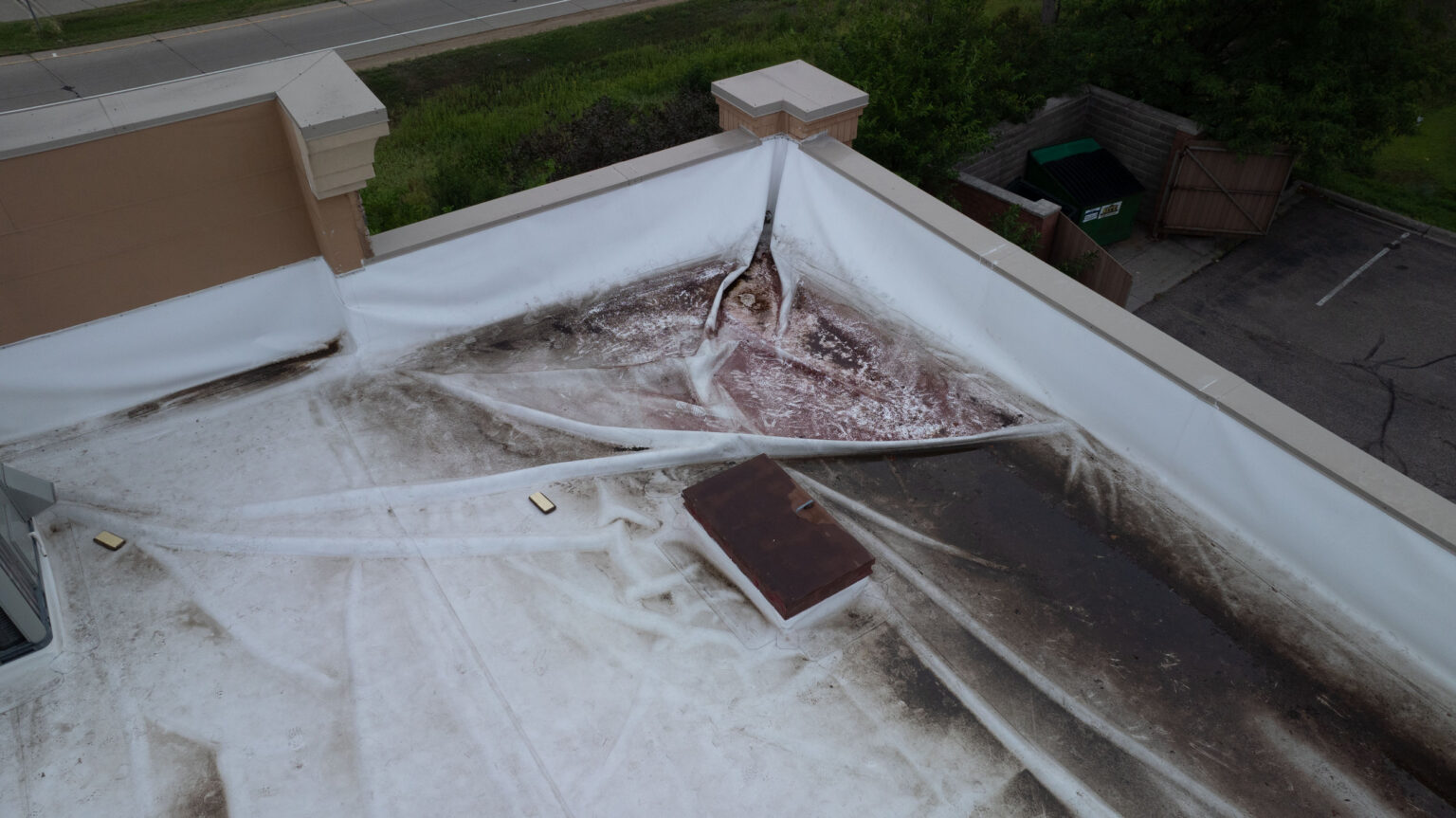
Grease contamination is the most common roofing failure mechanism on restaurant properties in Boise. Exhaust fans that are not properly maintained can discharge grease-laden vapor that condenses on the roof membrane surface around the penetration. Over time, this grease accumulation softens and degrades standard membrane materials, creating soft spots, loss of membrane integrity, and eventual waterproofing failure. Regular grease trap cleaning and exhaust fan maintenance by the restaurant operator reduces the contamination load, but the roofing system must still be specified with grease-resistant materials at all exhaust locations. Annual roofing inspections on restaurant properties should specifically assess the extent and severity of grease accumulation around each exhaust penetration.
Type I hood flashing requires specific materials and details that differ from standard commercial roofing practice. The hood exhaust curb is typically a grease duct that operates at elevated temperatures during service periods, and the roofing materials at the curb base must tolerate both grease contact and thermal cycling from the hot duct surfaces. Sheet metal flashings—typically 22-gauge galvanized or stainless steel—integrated with the roof membrane using appropriate sealants and counter-flashing details are the appropriate specification. The gap between the exhaust curb and the roof membrane must allow inspection and cleaning without compromising the waterproofing seal.
Fire suppression system penetrations on Boise restaurant roofs require coordination between the roofing contractor, the mechanical contractor, and the fire protection engineer. Ansul or similar wet chemical suppression systems serving Type I hoods have activation lines and detection cables that run from the hood through the kitchen ceiling and sometimes through the roof to external control panels. Each of these penetrations must be waterproofed with appropriate materials and must remain accessible for the annual inspection and recharge service that fire codes require. Improvised penetration seals that prevent access to fire suppression system components create code compliance failures that are discovered during fire marshal inspections.
High-frequency HVAC cycling is a distinctive feature of restaurant roof loading in Boise's climate. Restaurant HVAC systems cycle more frequently than those in office or retail buildings because kitchen heat loads vary dramatically between service periods and off-hours. Each cycle produces thermal movement in the roof membrane and HVAC curb flashings. The cumulative number of thermal movement cycles on a restaurant roof over 20 years far exceeds what similar-age roofs in other occupancy types experience. This accelerated cycling drives faster deterioration of caulk-based flashing seals and requires more frequent inspection and maintenance than non-restaurant commercial roofs.
Occupied operations at Boise restaurants during re-roofing require management of both scheduling and fume control. Many Boise restaurants operate seven days per week with both lunch and dinner service, leaving only early morning hours for construction activities that produce odors or noise that would affect diners. Solvent-based roofing adhesives produce vapors that can migrate into HVAC return air intakes and contaminate dining areas. Experienced restaurant roofing contractors sequence adhesive work away from active HVAC intake locations and schedule adhesive applications during closed hours when ventilation can flush the building before service begins.
Boise's climate creates specific challenges for restaurant roofs that other commercial building types in the same market do not face to the same degree. The combination of summer heat that accelerates grease degradation of membrane materials and the freeze-thaw cycling that tests flashing details at each exhaust penetration means that restaurant roofs in Boise age faster than comparable-age roofs on simpler building types. Annual inspections by a contractor familiar with restaurant-specific failure modes—grease contamination assessment, Type I flashing evaluation, fire suppression penetration review—are the minimum maintenance standard for Boise food service operators.
Selecting a commercial roofing contractor for a Boise restaurant requires verifying that the contractor has specific experience with Type I hood flashing systems, grease-resistant membrane specifications, and fire suppression system penetration coordination—not just general commercial roofing competence. A contractor who installs an office building roof on a restaurant property will install the wrong details at exhaust curb locations, creating a grease contamination failure within a few years that requires premature repair or partial replacement. Ask specifically how the contractor specifies Type I exhaust penetrations and what materials they use within the grease exposure zone.
- Silicone Roof Restoration
- Storm Damage Roof Repair
- Industrial Roofing
- Healthcare Facility Roofing
- Drone Roof Inspection
- Metal R Panel Roofing
- Energy Efficient Cool Roof Installation
- University Campus Roofing
Leak points, drainage, seams, penetrations, edge metal, roof access, and interior risk should be clear before the next roof decision is priced.
Immediate repair, maintenance, coating, recover, and replacement choices should be measured against roof age, moisture risk, tenant disruption, and budget timing.
A site visit is useful when the owner needs a documented roof condition, active leak response, storm review, or a clearer capital plan.