
Fitness Center & Gym Roofing in Boise, ID
Gym and Fitness Roofing in Boise: A Building That Fights Its Own Roof From the Inside
A health club is one of the few commercial buildings actively working against its own roof. Hundreds of people exhaling and sweating on an open training floor, showers and a sauna running all day, and on the bigger facilities a pool throwing humidity into the air for sixteen hours straight — that warm, wet interior air rises and pushes into the roof assembly from below. Most owners never think about it until a ceiling tile over the cardio deck starts to sag. Boise's fitness market has grown right alongside the Treasure Valley's population, with clubs lining the Eagle Road and Overland corridors, big-box gyms anchoring centers near the Boise Towne Square area, boutique studios in the BoDo and downtown blocks, and recreation-style facilities out toward Meridian and Nampa. They share a common roofing reality: dense rooftop equipment, brutal interior moisture, and operating hours that leave almost no window to work.
Interior Vapor Drive Is the Whole Ballgame
The mistake that ruins a gym roof is treating it like a retail box. Shower rooms, steam rooms, hot tubs, and especially pool enclosures generate humidity that wants to migrate up and condense the moment it hits a cold surface inside the assembly. If the vapor retarder is missing or sitting in the wrong plane for Boise's climate zone, that moisture collects in the insulation, the R-value collapses, and the deck starts to corrode from the underside where nobody can see it. A correct gym reroof in Boise starts below the membrane: we evaluate the existing assembly, confirm where the vapor control layer belongs for our cold-winter, dry-summer climate, and design the insulation and air barrier to keep interior moisture from ever reaching a condensing surface. The membrane on top is the easy part — the vapor strategy underneath is what keeps the roof alive.
The Penetration Count Is Double What You'd Expect
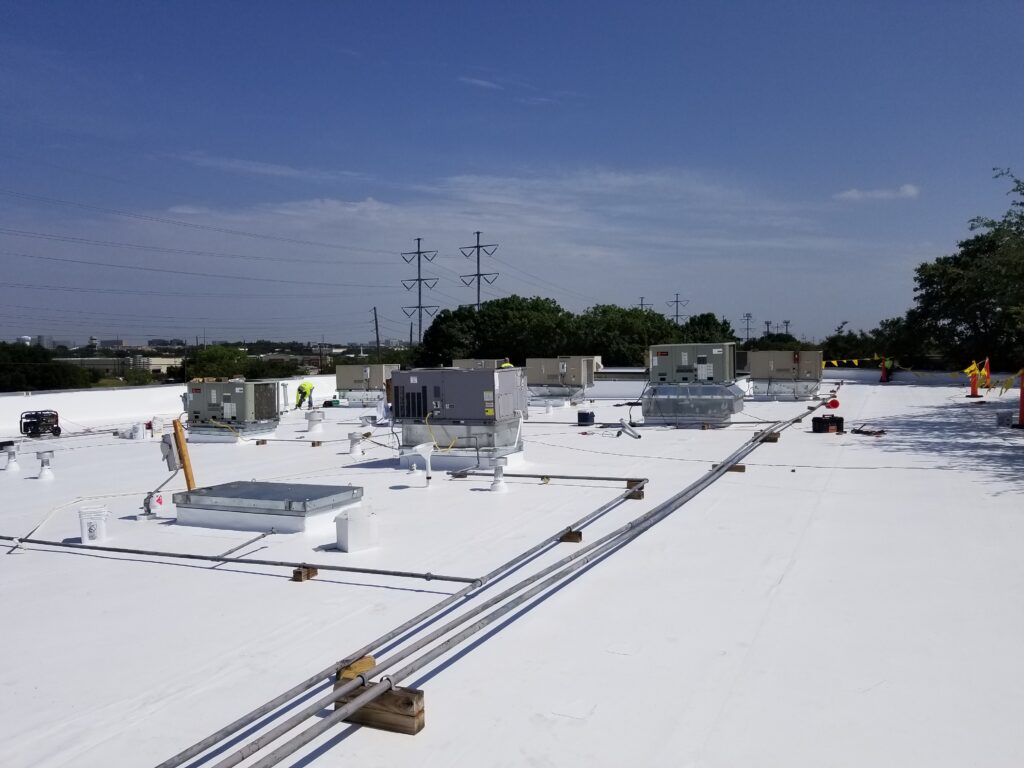
Fitness buildings are HVAC-heavy. A wide-open weight floor needs high-volume air handling just to manage the carbon dioxide and heat a packed room produces, and on top of that every zone — group fitness, spin studio, locker rooms, the pool hall — carries its own dedicated exhaust and make-up air. The result is a roof with two to three times the penetrations per thousand square feet of a comparable office or store. Every one of those curbs is a potential leak, and in a high-humidity building a sloppy curb flashing fails fast. We inventory every unit, curb, exhaust fan, and dryer vent before pricing, raise or rebuild any curb that sits too low to meet warranty flashing height, and detail each penetration for the moisture conditions these buildings actually run, not a generic spec.
What we typically specify for a Boise club
- Fully adhered 60-mil TPO or PVC on facilities with a pool, sauna, or steam — an adhered system removes the fastener field and gives a more vapor-tight assembly than mechanical attachment.
- A correctly positioned vapor retarder and air barrier matched to the interior humidity load and the local climate zone.
- Mechanically attached 60-mil TPO on dry, no-pool gyms where it is the economical and appropriate call.
- Rebuilt or raised HVAC curbs wherever existing heights would void the membrane warranty.
- Upsized drains and overflow scuppers to clear Treasure Valley snowmelt and summer cloudburst without ponding over an occupied floor.
Working Around 5 a.m. Openings and a Pool That Can't Go Down
Gyms run early and late — 5 a.m. to midnight is normal, and plenty of Boise clubs are a store has one. We build the schedule around the club's actual traffic: concentrate tear-off and the loud work into the lowest-occupancy hours the manager identifies, keep crews and noise away from locker rooms and studios during classes, and confirm watertight dry-in in writing before the next opening cycle. On pool buildings there is an added constraint — the natatorium HVAC and exhaust keep the air swimmable and meet state health requirements for commercial pools, so any work that touches those systems is coordinated with operations so the pool hall is never left without proper air exchange. That coordination is written into the proposal, not sprung as a change order.
Chains and Independents, Same Closeout
National operators run vendor-approval and corporate facilities programs, and we work inside those processes for chain locations in the Boise area. We also work directly with independent gym owners, boutique studio operators, and the commercial real estate investors who lease to them. Either way the building gets the same closeout package: pulled permit and final inspection, manufacturer warranty registered to the owner, a roof zone diagram with the full penetration inventory, drain and flashing inspection records, and photo documentation of the details. For corporate accounts we format that to drop straight into their facility management system.
Boise Weather on Top of an Already Wet Building
The interior moisture is only half the equation; the exterior climate is the other half, and it pulls in the opposite direction. Boise winters are genuinely cold, so the underside of the roof deck gets chilled while warm pool and shower air pushes up against it — a perfect condensation gradient if the vapor control is wrong. Wet, heavy snow loads the big flat expanses over the training floors, and the freeze-thaw cycling that defines a Treasure Valley winter works tired seams and flashings loose. Then summer flips it: long stretches of high, dry heat hammer a dark membrane with UV and surface temperatures that age it fast, while the foothill winds raise uplift on these wide, low buildings. We design the assembly for that full swing — vapor control sized for the winter gradient, attachment and edge metal for the wind, and drainage that clears snowmelt and the occasional hard summer downpour before it can pond over an occupied floor. A reflective membrane also takes load off cooling systems that are already running hard for a packed gym.
Catching Problems Before They Hit the Floor
The most expensive gym roof failures are the slow ones — moisture creeping into insulation over a year or two until the deck corrodes and a section has to be torn out. Because these buildings generate their own humidity continuously, they reward regular eyes on the roof. We offer scheduled inspections that check the high-risk spots on a fitness building: the exhaust curbs over the locker rooms and pool, the laps and seams that take the most thermal movement, the drains that have to keep working through snow season, and any sign of condensation staining showing up at the deck. Catching a lifted seam or a failed curb flashing in a fall inspection is a half-day repair; finding it when it has already soaked the insulation over the weight floor is a tear-off. For owners running multiple Boise locations we keep that documentation consistent across the portfolio so the whole real-estate footprint is on the same maintenance footing.
Get a Straight Read on Your Boise Gym Roof
If you are seeing ceiling stains over the floor, condensation dripping near the pool, or curbs that look like trouble, we will get on the roof, check the assembly for trapped moisture, and lay out a scope focused on your hours and your humidity load. Reach out and we will put together a clear plan for your facility.
Leak points, drainage, seams, penetrations, edge metal, roof access, and interior risk should be clear before the next roof decision is priced.
Immediate repair, maintenance, coating, recover, and replacement choices should be measured against roof age, moisture risk, tenant disruption, and budget timing.
A site visit is useful when the owner needs a documented roof condition, active leak response, storm review, or a clearer capital plan.